
Imagining New Worlds through Language
How a simple Greek distinction between two types of action can prompt profound reflection on happiness and meaning

(Note: This is a re post of an old past as it is likely most of my subscribers have not read my old posts. I hope you enjoy it. For next two or three months I will only be posting one original post per month due to some other responsibilities I have at this time. So look for a new post toward the end of December!)
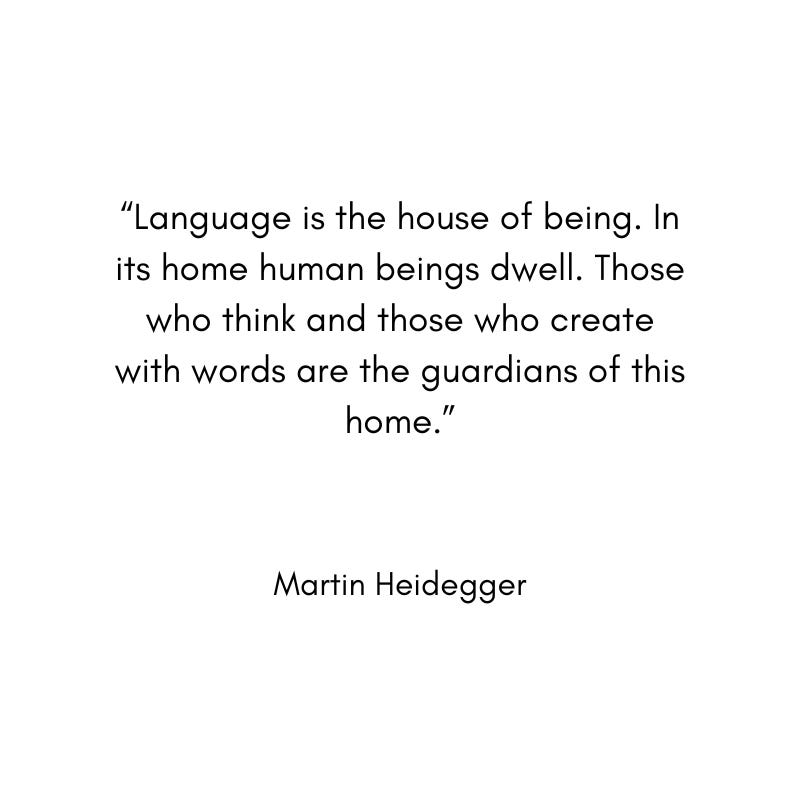
German philosopher Martin Heidegger believes in the transformative power of language. In much of Heidegger’s work, he simply leaves Greek terms untranslated, without even a footnote to illuminate the meaning. Although this can be frustrating to the reader, if we take this as a signal to slow down, research, and carefully contemplate the meaning of the term instead of quickly translating it into a familiar term it can be a profound philosophical exercise. Some concepts are so rich that understanding them can uproot lifelong metaphysical and ethical assumptions. The presentation of a contrast case to our own conceptual schemes can contextualize and even unhinge those schemes by illustrating that their ground is not in an unchanging reality but in the particular way our linguistic scheme organizes and demarcates experience. Heidegger writes of the power language has in shaping our world, “Language is the house of being. In its home human beings dwell. Those who think and those who create with words are the guardians of this home.”
Heidegger thought that by making use of Greek terms he could encourage readers to inhabit the world of Ancient Greece. Personally, I do not think that simply understanding the language of a culture can lay bare the “essence” of that culture’s worldview. A culture’s way of living and worldview is constituted by a whole network of causes, only one of which is language; and further no culture, way of life, or worldview is static. Cultures are continuously being transformed through internal dialogue and creative activity as well as external interactions with other cultures across time and space. When we point to any particular worldview as a static, determinate, and unchanging thing, we must make an artificial boundary by separating out one moment in time and space from the dynamic, ever-changing historical, natural, and cultural forces that this moment is embodying, reinterpreting, and transmitting into the future. From this point of view, a “culture” is the momentary stability of a metaphysical and ethical consensus amongst a group of people that will inevitably be transformed as the fundamental principles on which that consensus is based are challenged through external influence and internal transformation. Although it would be inaccurate to think we can read off the essence of the Greek worldview from Greek concepts, we can use certain Greek concepts as a vector of meaning to destabilize the solidity of the principles that underpin the consensus of our culture. This is not a project concerned with ultimate truth but a creative and normative project, a way of using alternative ways of thinking and conceptualizing to destabilize ethical and metaphysical assumptions that, at least from my point of view, may not serve our well-being as individuals or a community.
One such distinction in Greek that can shake our normative orientation is Aristotle’s distinction between poiesis and praxis. This distinction is simple, and I would claim it is here that its power lies. Aristotle invokes this distinction to demarcate two fundamental kinds of human activity. An action referred to as poiesis is an action that gains its structure and meaning from the end it aims at. We are all very familiar with this type of activity. Most of us spend the majority of our day performing actions that aim at some end or accomplishment. Whether that end is career advancement, learning a particular skill, physical health, or spiritual development doesn’t matter. What makes an action poiesis is simply that the action gets its meaning from and is structured through the end it is aiming at. Praxis on the other hand does not gain its meaning or its structure from some end it aims at because, with praxis, it is the action itself that is its own end. Praxis simply exists to exist, gaining its meaning simply from the act of being and being performed. I am sure we are all familiar with activities that could be grouped into this category as well. We may hang out with friends just for the enjoyment of being in good company, or go on a walk in the woods just to enjoy moving our bodies and the rustle of the wind through the trees. The way Aristotle discusses the relationship between these two ways of acting may seem radical to our culture. Aristotle argues that praxis is necessarily “higher” than poiesis. Aristotle reasons that if any poiesis did not eventually end in a praxis, then that poiesis would be self-contradictory. This is because the end that provides that poiesis with its meaning, value, and structure would never come; that which gives our action its foundation of meaning and value would not exist. A poiesis would not need to immediately end in a praxis. There could be a chain of different activities aimed at ends that eventually end in praxis. A praxis can also be embedded in a poesis. (These essays are a good example of this, they do produce something but are also valuable in themselves for me as a creative activity.) However, there does need to be a praxis involved in some way to ground the poeiesis according to Aristotle. If not, life would consist of an infinite waiting for meaning. As Aristotle writes in the Nicomachean Ethics, “the process would go on for infinity, so our desire would be empty and vain.”
In my observations, Aristotle’s simple distinction poses a threat to the existential and normative bedrock of the day-to-day existence of many in American culture. Of course, we all undertake both these types of actions but it seems to me that our culture conditions us to value ourselves and derive meaning from life primarily in regards to how successful and productive we are. We are encouraged to derive meaning from the material goods or status we acquire and what we are able to contribute to society in a way that can be quantitatively measured. Those who have high-paying jobs, college degrees, or a long list of resume-worthy accomplishments are often deemed as superior in an almost moral sense. Praxis-like activities are more something we are encouraged to do on the side, to make sure we don’t burn out from our main task of productivity. In myself, I see an inner critic that rewards me with positive mental feedback when I am undertaking poiesis. This same inner critic often produces feelings of anxiety and self-judgment when I choose praxis-like leisure activities instead. This distinction encourages us to consider that it is the encouragement to find meaning in a type of activity that, in fact, cannot produce meaning on its own that is one of the (of course many) causes of the mental health crisis and lack of meaning in our culture. (In 2019 a survey in the UK reported that 9 out of 10 people aged from 16 to 29 thought life was meaningless). If we agree with Aristotle’s ordering of these two types of activity it would make sense that any attempt to derive inherent meaning from poiesis would leave us empty-handed. If this is true, rather than asking ourselves what will allow us to be successful and productive, maybe we should instead ask what types of activities allow us to enter into a simple enjoyment of being and living itself only then determine which poiesis activities are needed to help make that a part of our lives.
Although our own word “action” does cover the scope of the meaning of both poiesis and praxis, simply making a distinction between these two types of actions gives us the conceptual possibility of asking profound questions about the nature of meaning and human happiness. The ways we categorize and conceptualize even very mundane aspects of our lives have powerful effects on how we orient ourselves in life and where we search for meaning and satisfaction. When we realize this power of language, we may find that simply encountering concepts from other languages can prompt deep philosophical reflection and even normative re-orientation. Before closing let me leave you with one more from the Greek language to contemplate for yourselves. The Greek language has four distinct words for love: Agape (Love of the Divine), Philia (Love of a Friend), Eros (Erotic Love), Storge (Family Love). How might attending to the distinct flavor of these forms of love enrich our understanding of the way care, openness, and intimacy flow differently in different relationships and different contexts? How might attaining a familiarity with these
flavors of Love help us sense when each kind of Love is appropriate at which time? I hope you can also take this contemplation further, allowing alternative linguistic concepts that may seem hard to grasp at first to encourage philosophical reflection for yourself.
If you found this reflection valuable, please consider subscribing. Paid Subscribers have access to all four posts per month, while non-paid subscribers have access to two posts per month.
Please feel free to leave a comment if you have clarification questions, feedback, critiques, or anything to add. Philosophy is all about dialogue! I will do my best to respond to all questions and concerns.