
Resistance as Grace
What I learned from writing poetry that rhymes

If you walked down the street of any American city and asked a good sample size of people, “How can humans figure out the laws of the universe?” most would propose natural science as humanity’s best bet. A few liberal arts college students might mention philosophy, logic, anthropology, or sociology. You would probably be hard-pressed to find anyone who mentions art. People would likely praise art’s ability to help us express and process our “subjective” feelings, experiences, or perspectives, but very few, if any at all, would suggest it can help us discover the laws and patterns of the universe.
As is the case with many unanalyzed assumptions, a study of history reveals that this stark division between the arts and the sciences is a historical development, not a self-evident truth. Some of the most influential thinkers in the Western tradition, such as Plato, Aristotle, Hegel, and Kant, task art with the lofty goal of contemplating and expressing the deepest truths of nature and Being. Although a great love and respect for the artistic process is integral to the Western philosophical tradition, so is a great love and respect for fixed hierarchies. Western thinkers who praise art as capable of this lofty goal often also suggest that science, reason, and logic grasp the truth more richly and comprehensively than art ever could. An oversimplification of these hierarchical rankings into a fixed division is likely one of the primary causes of the “subjectivist” view of art that is so common today. In my estimation, these philosophers are too fond of hierarchy. The intimate nature of the artistic process can unveil dimensions of Truth that the detached attitude necessary for rational or scientific contemplation conceals. (Of course, this goes both ways; the detached engagement of science and rationality shows us things artistic engagement cannot.)
Let me explain with a personal example. Over the past few months, I have started writing poetry. The act of writing has attuned me to a pattern of experience within human life that is often overlooked: encountering resistance to our own agenda, whether that agenda be a life goal, a belief system, or a momentary desire, is almost always an opportunity for personal growth. This is important to discuss because our culture teaches us quite the opposite. Every culture instills its children with a sense of how to live a good life. One of the primary features of the American “good life” is a life with no resistance to our agendas and desires. Smartphones, Amazon Prime Now, DoorDash, and many other modern must-haves all have one thing in common: they eliminate any friction between what we want and when we get it. It is as if the “American Dream” has become a life where there is no gap between the arising of desire and the satisfaction of desire. Although technology is exacerbating this lifestyle by making instant gratification possible in more areas of life, this general orientation has always been an integral part of the American Dream. As I was growing up, having enough money to pursue leisure activities like going out to eat or going to the movies whenever I felt inclined was praised as a worthwhile goal in life by the media, family, and teachers alike. Of course, teachers and family members had much real wisdom to share as well, but it is telling that this emphasis on a lifestyle where I can satisfy my desires and whims as they arise was emphasized as equally essential.
Given this cultural conditioning, it is no surprise that when I started writing poetry, I had no interest in any medium but free verse. Following a strict meter and rhyme would only limit my free, creative expression. I wanted to use poetry to directly express my ideas to the world without the mediation of an external form that would impose unnatural, arbitrary limitations on those ideas. Or at least this is what I thought. Don’t get me wrong. I love free verse poetry, and I still enjoy writing it. It was not free verse itself that was the problem, but the belief I had that writing within a restricted form would be unnatural, stifling, and limiting.
My first experiment with rhyme and meter came after I took a class on Sufi poetry. I was inspired by what I had read and studied, so I sat down to write a ghazal, a traditional Sufi poetic form. My initial experience with using a fixed poetic form was resistance and frustration. I had certain ideas and feelings that I was convinced were very profound. Try as I might, I simply couldn’t fit my conceptual plan for the poem into the scheme. Fortunately, out of respect for the Sufi masters I had just spent a semester reading, I stuck with the scheme. After many frustrating attempts to fit my ideas into the form, I gave up. I realized that I couldn’t just come up with ideas and then put them into the poetic form. I had to start with the meter and rhyme scheme, start with the thing that wasn’t coming from “me.” I had to let the scheme be the master and my own ideas be the servant. While writing free verse felt like a process of translating my own ideas into poetic form, this was something entirely different. I had to let the poetic scheme act as the primary creative force, not my own free-wheeling philosophical musings.
When I let this happen, something unexpected but incredible happened. The poem I was writing dealt with some personal challenges. As I wrote with the poetic scheme instead of trying to fit pre-made ideas into it, the verses that emerged expressed a new perspective on these challenges. The verses revealed and expressed a deeper logic of growth and transformation, of which these struggles were a manifestation. At this more fundamental, archetypal level, the process I was going through was a totally natural and organic process of existential transformation, not the misfortune it seemed to be when I interpreted these struggles at a more personal and emotional level. To allow this recognition of the deeper causes of my challenges to arise, I had to let go of my habitual tendencies to manage those challenges, minimize the painful emotions associated with them, and take them personally. I realized that the “resistance” I had felt at writing within the poetic scheme was, at least in part, a resistance to delving underneath the personal and emotional elements of these experiences.
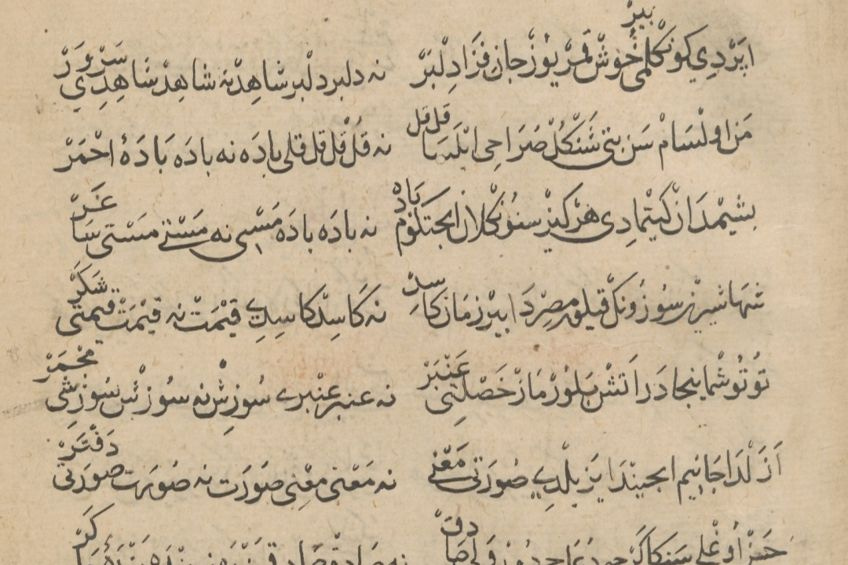
I think these traditional poetic forms have a mysterious power that instigates a penetration into the deeper layers of reality when we allow them to guide our creative process. However, I would not limit what I learned through this experience to the activity of writing in traditional poetic forms. I am quite confident this process helped me become aware of a pattern of cause and effect that holds true in any context. When we try to ignore resistance, we live locked within ourselves, our habits, and our acquired knowledge, refusing to let the outside world in due to our fear of its unpredictable and spontaneous nature. If everything we want and think immediately manifests in objective reality, we are literally revolving in a dream state of self-absorption. In this state, our entire life process consists of seeing our internal beliefs and desires manifested in the outside world; we literally see only ourselves wherever we look. When this process is met with resistance, whether it comes from a fixed artistic form, the natural world, the limitations of our physical body, others who won’t do what we want, or anything else, we are shaken out of our dream state of self-absorption and forced to engage intuitively and creatively with something we cannot control. If we meet a challenge like this with an open mind and an open heart, it will put us in the present moment, encourage us to respect and learn from what we might not fully understand, and even challenge some of our most dearly held ideas and views of what we want, what the world is, or who we are. Many of us (including myself at times) dedicate much energy to avoiding or ignoring situations that generate resistance to the gratification of our desires, beliefs, and expectations. Although this is quite understandable, experiences like the one I had writing the ghazal demonstrate that it is in letting go of the desires, beliefs, and interpretations we cling to most tightly that a deeper understanding of and engagement with life is born.
In this way, engaging in the creative process with an open, surrendered attitude has the power to encourage an integration of the patterns that govern nature into our being in a way that detached conceptual reflection never could. While I may have been able to reason to this truth and understand it as an abstract principle, this is not the same as experientially tasting the wisdom and opening that leaning into resistance can bring about. Art, and other practices such as meditation, spending time in nature, spending time with wise people, and simply paying close attention to how our body and mind respond to different experiences, are all ways I have been able to get a feel for attuning to natural patterns. When we undertake practices that encourage us to move with the patterns of nature, we go further than arriving at a conceptual map of reality by attuning our entire embodied engagement to its natural flow.
If you found this reflection valuable, please consider subscribing.
Please feel free to leave a comment if you have clarification questions, feedback, critiques, or anything to add. Philosophy is all about dialogue! I will do my best to respond to all questions and concerns.
Are there any English ghazals (or English translations) you can recommend which demonstrate the poetic form?